
What is Divorce Mediation?
Divorce mediation is a process in which an independent, neutral, third party (a mediator) meets with you and your spouse and tries to help the two of you work out an agreement on some or all of the issues in your divorce. The mediator doesn’t represent you or your spouse. Rather, the mediator acts as a facilitator to help you and your spouse talk to each other constructively and come up with a settlement that each of you will accept.
Key Takeaways
Divorce mediation is fundamentally about agency, informed choice, and control.
1. A mediator does not decide your divorce. You and your spouse do.
The mediator doesn’t act as a judge: they don’t issue orders, grant divorces, or give legal advice. Their job is simply to facilitate conversation and help you and your spouse generate settlement ideas.
2. Full financial transparency is essential for mediation to work.
Both parties must share details about income, expenses, assets, and debts — with each other and the mediator — to ensure any agreement is grounded in reality.
3. Mediation is more about control, creativity, and collaboration than adversarial win/lose.
Because you’re negotiating directly with each other (with a neutral facilitator), mediation allows for more customized and flexible arrangements — often ones a court might never consider.
4. Mediation tends to be faster, cheaper, and less emotionally draining than going to court.
Compared to traditional litigation, mediation typically saves time, reduces legal fees, avoids the public record and procedural delay, and helps minimize the emotional toll on both parties.
5. Mediation can result in agreements that are more durable and acceptable — but it’s not a guaranteed “quick fix.”
A successful mediation isn’t just a signed agreement; it’s one that both spouses genuinely believe is fair (or at least equally acceptable). If one spouse “caves,” or if financial disclosures are dishonest, the agreement might be flawed — and possibly undone later.
How Does The Divorce Mediation Process Work?
Mediation can be voluntary (i.e., you and your spouse agree to go because you want to stay out of court) OR a court can order you to go to mediation. However, while a judge can order you to mediate your divorce, s/he can’t order you to agree to settle your divorce in mediation. If you or your spouse won’t voluntarily accept a settlement, the mediation is said to have “failed” or “reached impasse.” When that happens, your only option is to go (or go back to) court.
Like in litigation, mediation begins with information gathering. Unlike in litigation, however, in mediation, you and your spouse are expected to voluntarily produce your relevant financial information to the mediator and to each other. There is no formal “discovery” process in mediation.
If either you or your spouse refuses to voluntarily produce information, the mediator can’t force you to do that. If either of you won't produce information (or if one of you is purposely hiding information), mediation won't work.
In traditional mediation, lawyers do not attend mediation sessions with you. However, there is also “lawyer-assisted mediation,” where you, your lawyer, your spouse, and your spouse’s lawyer all attend the mediation sessions together. This type of mediation provides more support for someone who isn’t confident mediating on their own.
Even if you’re mediating without lawyers, it’s still extremely important for you to talk with your lawyer before the mediation process begins. You have to understand how the law works, and what your rights and responsibilities are BEFORE you start mediating! Otherwise, you're likely to either give up the farm or make totally unrealistic demands, because you don't know what you are really entitled to get.
If you and your spouse reach an agreement in mediation, the mediator will write up your agreement for you. Your mediated agreement will likely be called “A Memorandum of Understanding” or a “Mediated Settlement Agreement.” You can then take that agreement to your lawyer. S/he will review it and incorporate it into your final divorce documents.
What Does a Divorce Mediator Do?

The role of a divorce mediator is to help you and your spouse reach an agreement.
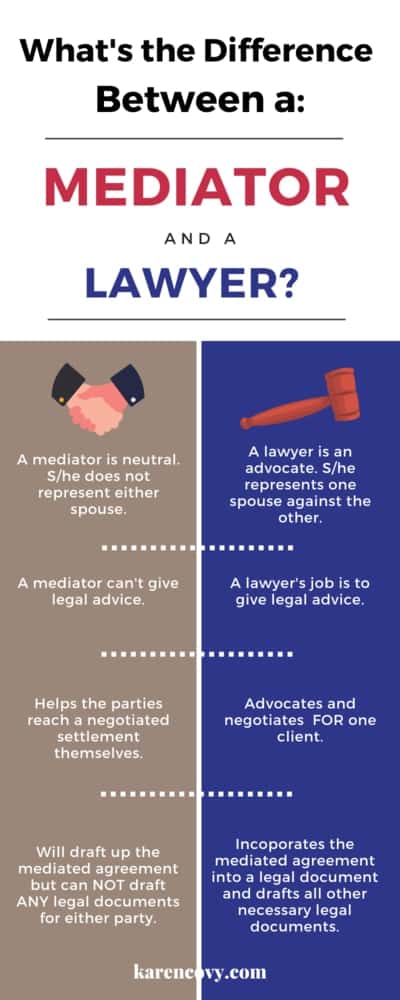
To perform that role effectively, the mediator has to be independent. That means that the mediator does not represent you or your spouse. The mediator is neutral.
Because a mediator is neutral s/he can't give either you or your spouse legal advice. The mediator can not tell either you or your spouse what you should do to get the best deal. Doing that would destroy the mediator's neutrality.
A mediator does not take sides. S/he is not there to see that anybody "wins." The mediator is focused solely on helping you and your spouse negotiate with each other so that you reach an agreement. How that agreement shakes out is up to you and your spouse. (Of course, if the agreement you're making is really one-sided your mediator will probably urge you and your spouse to talk to lawyers before you finalize that agreement.)
Another important thing to realize is that a mediator can not force you and your spouse to make an agreement. S/he can only work with you and your spouse to try to help you and your spouse find common ground and settle your issues. If you don't reach an agreement, then your mediation will fail. If that happens, your divorce will end up back in court for a judge to decide.
What's The Role of a Divorce Lawyer in Mediation?
The role of a lawyer in the divorce mediation process is to be your adviser and your advocate. Unlike a mediator, your lawyer is not neutral or independent. Your lawyer represents you.
In your divorce, your lawyer will advise you about the law in your state. S/he will also help you understand how the law applies in your case. Your lawyer will make sure you understand the kind of result that you might get if you went to court. (Of course you never really know what would happen if you went to court unless you actually go to court. But your lawyer can still give you a general idea of what would probably happen if you went to court.)
Your lawyer will also help you identify your objectives for mediation. S/he will help you figure out what you want to achieve. S/he will also help you make a plan and devise a strategy so that you can achieve your mediation goals.
Do You Need a Divorce Mediator AND a Lawyer?
Yes! The roles of a divorce lawyer and a mediator are very different. Lawyers are your advocates. Mediators are neutrals. To mediate your divorce effectively, you need both a mediator and a lawyer.
For example, if you want to negotiate effectively, you first have to understand your legal rights and responsibilities. You have to know things like how child support will be calculated and whether spousal support will be an issue in your divorce. You need to know your options for dividing your property and debts based on the law in your state.
In short, you need to know the basics of what you will likely be entitled to get and what you will likely be required to give in your divorce.
Lawyers give you the legal advice you need to be able to negotiate knowledgeably and confidently.
You also need a lawyer to draft all of your divorce documents for you.
In most places, the only document your mediator will write for you is your Mediated Settlement Agreement. But that's only one of the documents you need in your divorce. You need a divorce lawyer to draft the other documents that will get you from the beginning of your case to the end.
Will Divorce Mediation Resolve My Case?
Divorce mediation can be an incredibly successful way of resolving your conflicts with your spouse in a healthy way. But it's not a substitute for going to court.
A divorce mediator is not a judge. S/he has no power to order you or your spouse to do anything, nor does the mediator have the power to actually grant your divorce. Only a judge can do that. The mediator’s sole job is to help you settle your own case in a way that makes the most sense for you and your family.
Once your divorce is settled, you MUST take your paperwork to a judge, who will review it and sign off on it. Only a judge can grant you a divorce, no matter what divorce process you use.
What Are the Benefits of Divorce Mediation?
Divorce mediation provides you with benefits you can't get in court:
1. It's Private.
Mediation sessions occur in a mediator's office, not a courtroom. There's no record of what goes on in the mediation sessions. The only ones who know what you talked about are you, your lawyers, and the mediator.
2. It Gives You More Control.

You can't choose your judge, but you can choose your mediator. If you have issues in your divorce that need special expertise (like highly complicated financial matters or kids with special needs) you can find a mediator who has experience in THAT particular area.
You also can't control what a judge will do. If you try your case in court, you're stuck with whatever decision the judge makes. (... unless you appeal, but that generally takes months or years and tens of thousands of dollars to do.) If you mediate your case you have input into the agreements you make. You can also be more creative and reach agreements that a judge would never order.
Mediation gives you more control over the timing of your case. Most courts are seriously backed up. When you go to court, you're stuck dealing with the judge's calendar. Mediators typically aren't as backed up as judges. (And if a particular mediator does have a really tight schedule, you can always find a different mediator.)
3. It's Less Expensive Than Going to Court.
Trials are complicated. They take an enormous amount of a lawyer's time and energy to prepare for. That means they cost you a LOT! Mediations are less formal, less complicated, and easier to prepare for. So even if your lawyer attends mediation sessions with you, it's still going to cost you a lot less than going to trial.
4. It's More Efficient Than Going to Court.
Letting the lawyers negotiate your divorce is like playing a giant game of "telephone." First, you have to talk to your lawyer. Then your lawyer talks to your spouse's lawyer. After that, your spouse's lawyer talks to your spouse. Then the whole process reverses itself. Not only does this method of negotiation take an enormous amount of time, it also lends itself to misunderstandings. With so many people transmitting messages, it's easy for what's being said to get messed up. (Of course, the lawyers can put everything in writing, but that takes even longer and costs even more.)
A mediator puts everyone in the same room (or rooms) at the same time. That ends a lot of miscommunication and usually helps you settle your divorce far more quickly and efficiently.
5. You're Far Less Likely to Return to Court After Your Divorce if You Mediate.
When you participate in your own settlement negotiations, you're far more likely to reach an agreement you can live with. That makes it less likely that you'll return to court to fight about that agreement later. What's more, if a dispute does arise in the future you can always go back to the same mediator to resolve it.
Why Use Divorce Mediation?
If you could negotiate directly with your spouse, you wouldn’t need a mediator. But most people can't do that ... which is precisely why you need a mediator.
If you litigate your divorce all the way through trial, you may not (and probably will not) be completely satisfied with the judge’s decision. The judge can order you to do things you would NEVER do otherwise.
If you let your lawyer negotiate your divorce, you'll pay a LOT for that privilege. Every time your lawyer picks up the phone, or reads an email, or writes a settlement proposal, you pay for his/her time. Since few cases settle after a single round of negotiations, your legal fees will quickly start to skyrocket. Mediating your divorce is much less expensive.
The Bottom Line
Mediation is a much more amicable, efficient, and affordable way to resolve your divorce issues ... but it's not for everyone. If you or your spouse is determined to hide assets, divorce mediation won't work. If domestic violence is involved in your marriage or there's a power imbalance and you are afraid to stand up to your spouse (even with your lawyer present) mediation won't work. Finally, if one of you won't negotiate in good faith, divorce mediation also won't work.